Law 10 · Reasoning & Planning
More Thinking Can Hurt
Extra reasoning past the answer is wasted, or a wrong turn.
The principle
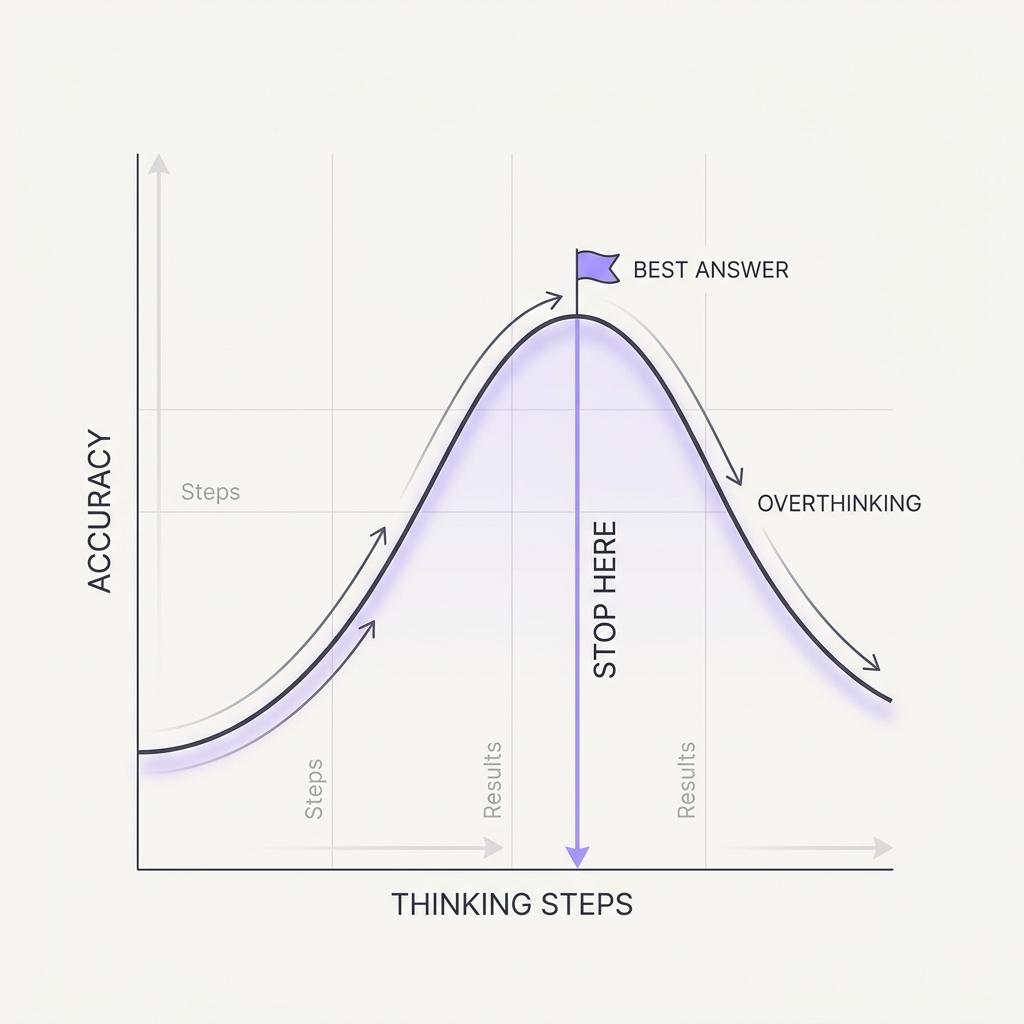
More reasoning isn't automatically better. On easy tasks it just burns latency and money for nothing. On some tasks the model finds the answer early and then talks itself out of it. Reasoning depth has a useful range, not an endless upside.
Why it happens
Reasoning has a budget, and more budget is not always more accuracy. Overthinking studies show models can spend unnecessary tokens on simple arithmetic or reach the right answer early and then drift away. Apple's Illusion of Thinking made a stronger claim about reasoning collapse, but that paper was contested and later work found a mixed picture with evaluation artifacts and real limits. The practical lesson survives: cap easy paths, escalate hard paths to tools or verifiers, and do not confuse a longer trace with a better answer.
Watch for
- Trivial lookups take seconds and cost multiples because everything is routed through extended reasoning.
- The model reaches a correct answer early, keeps deliberating, and lands on a wrong one.
- Longer thinking traces show no accuracy gain, or even a drop, on your easy cases.
In practice
You route every order-status lookup through extended reasoning to be safe. The answer is a direct database field, but the agent now takes eight seconds, costs several times more, and sometimes talks itself away from the obvious result. More tokens did not add information. Match the thinking budget to the task: skip extended reasoning for simple lookups, use bounded reasoning for ambiguous judgment, and use tests or tools rather than endless deliberation when stakes are high.
Apply it
- Match the reasoning budget to problem difficulty rather than maxing it out everywhere.
- Cap or skip extended thinking on simple, low-stakes steps like direct lookups.
- Stop once a confident answer is reached instead of letting the model keep re-deriving.
The takeaway
Match the thinking budget to the task. Cap or skip extended reasoning on simple paths, and lean on external checks rather than endless deliberation on the hard ones.
Sources and further reading
- Do NOT Think That Much for 2+3=? On the Overthinking of o1-Like LLMs · Chen et al., 2024
- The Illusion of Thinking: Understanding the Strengths and Limitations of Reasoning Models · Shojaee et al. (Apple), 2025
- Comment on The Illusion of Thinking · Lawsen, 2025
- Rethinking the Illusion of Thinking · Varela et al., 2025